Rare earths now have a Western price, and governments set it
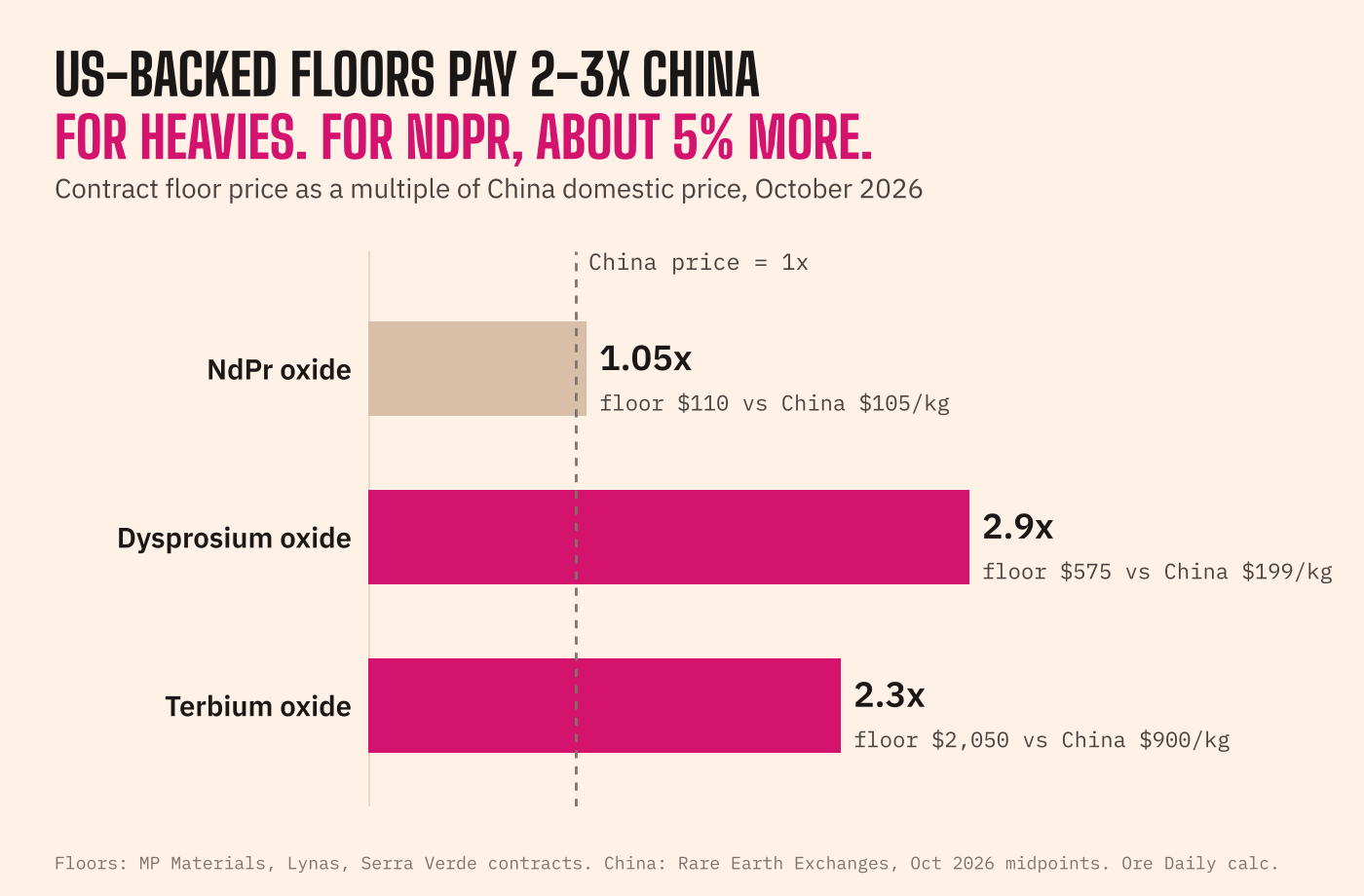
The US$110/kg NdPr floor barely clears Chinese spot. For dysprosium and terbium, US-backed floors pay two to three times China's price.
Lynas Rare Earths sold its product at a record A$102.1/kg last quarter, up 88% on the year, and floor-price contracts now cover more than half its output. For the magnet metals that matter most, the price outside China is increasingly a number governments write into contracts, not one a market finds.
The number they keep writing is US$110/kg for NdPr. The Pentagon, Japan and a US-backed vehicle in Brazil have all committed to it. For the heavy rare earths dysprosium and terbium, the floors sit at two to three times Chinese prices, by Ore Daily's calculation.
“I foresee this restriction to be further strengthened”
The $110 club
MP Materials set the template. Its 10-year price protection agreement has the Pentagon pay, each quarter, the gap between US$110/kg and a benchmark average price on every kilogram of NdPr it produces. Once its 10X magnet plant runs at full capacity, the government takes 30% of anything above US$110. The deal also brought US$400 million of Pentagon equity and a US$150 million loan.
The payments show how close the market has come to the floor. MP booked US$42.3 million of floor income in Q1 2026 and US$17.6 million in Q2, a 58% drop, as Chinese NdPr prices climbed. Even the smaller sum was about 62% of MP's Q2 adjusted EBITDA of US$28.5 million.
Lynas copied the number. A revised deal with Japan's JARE commits to at least 5,000 t/yr of NdPr at a US$110/kg floor through 2038, plus at least half its heavy rare earth output, with upside shared above US$150/kg. A US letter of intent redirects US$96 million, once meant for a Texas plant, to buying Lynas oxides over four years at the same floor.
Serra Verde took the idea to heavies. The Pentagon committed US$750 million to a US$1.55 billion vehicle backing a 15-year offtake of the Brazilian mine's Phase I output, with a forward purchase of at least US$300 million over five years. Its floors are US$110/kg for NdPr, US$575 for dysprosium and US$2,050 for terbium, escalating 2% a year, and the mine keeps 70% of any price above them. USA Rare Earth, itself backed by a US$1.6 billion federal package, is buying Serra Verde.
Heavies are where the split is real
For NdPr, the two-tier market is thinner than it looks. Rare Earth Exchanges puts October ex-China NdPr oxide about 27% above the Chinese price. Benchmark had it the other way in August, with ex-China at US$95/kg against about US$107.5 in China. Either way, the floor and Chinese spot are now close.
Heavies are a different market. Dysprosium oxide outside China is assessed at US$2,500–5,500/kg against US$196–201 inside, and terbium at US$10,000–13,000 against roughly US$900. Those ex-China quotes rest on thin trade. The IEA, using Benchmark data, puts European dysprosium and terbium prices at about five times Chinese domestic levels. The Serra Verde floors sit between the two worlds, well above China and well below the scarcity bids.
Why governments are paying
The market alone has not moved the supply chain fast enough. China refined 84% of the world's magnet rare earths in 2025, 75kt of 89kt, according to the IEA's Critical Minerals Data Explorer. In the IEA's base case that share only falls to 73% by 2030, even as refining outside China roughly doubles to 30kt. Refined supply of 111kt that year still trails stated-policies demand of 116kt.
The IEA's Global Critical Minerals Outlook 2026 makes the case for floors directly. It says price mechanisms such as floors and contracts for difference suit small, opaque, concentrated markets like rare earths. It also argues the cost is small: rare earths are about 40% of a magnet's cost but less than 1% of a car's value, and tripling rare earth prices would add about 0.1% to the price of a car.
The gap is now downstream. Planned magnet capacity outside China equals only about a third of the mined supply expected outside China by 2035. Costs are rising too: sulphuric acid has climbed to over 20% of rare earth cash costs, from 5% before the Middle East conflict, the IEA says.
The catch, and what to watch
Floors fix the price, not the volume. Lynas' record price still left quarterly revenue 18.2% below consensus as sales volumes fell 17.7%. Its Malaysian plant shuts for a month this quarter, and Kalgoorlie for two weeks.
Floors also shift risk to taxpayers. If Chinese NdPr slides back towards its 2024 lows of around US$49/kg, the bill for every floor rises with it. And floors protect producers, not magnet makers or carmakers, who still compete with factories buying at Chinese domestic prices.
The next tests come quickly. China's one-year suspension of its expanded October 2025 rare earth and battery export controls runs out in November, with no notice yet on what comes next. On Nov 5, MP Materials reports Q3; the size of its floor payment will show how far below US$110 Chinese NdPr sat from July to September.
Sources The Edge (Reuters): Lynas Q1 FY27, Oct 29 · MP Materials 8-K: DoD price protection agreement · MP Materials Q1 2026 results · MP Materials Q2 2026 results · TechTimes: Lynas floors · TechTimes: Serra Verde floors · Defence Agenda: Serra Verde SPV · Rare Earth Exchanges: October 2026 prices · Lynas June-quarter call transcript (Investing.com) · IEA (2026), Critical Minerals Data Explorer, CC BY 4.0 · IEA (2026), Global Critical Minerals Outlook 2026, CC BY 4.0