Iron ore has sunk into its cost curve. About a tenth of the losers have blinked
UBS puts 150–170Mt of supply under water below US$90. Cuts so far cover 15–20Mt. China's own mines are doing most of the retreating, and Simandou is still ramping up.
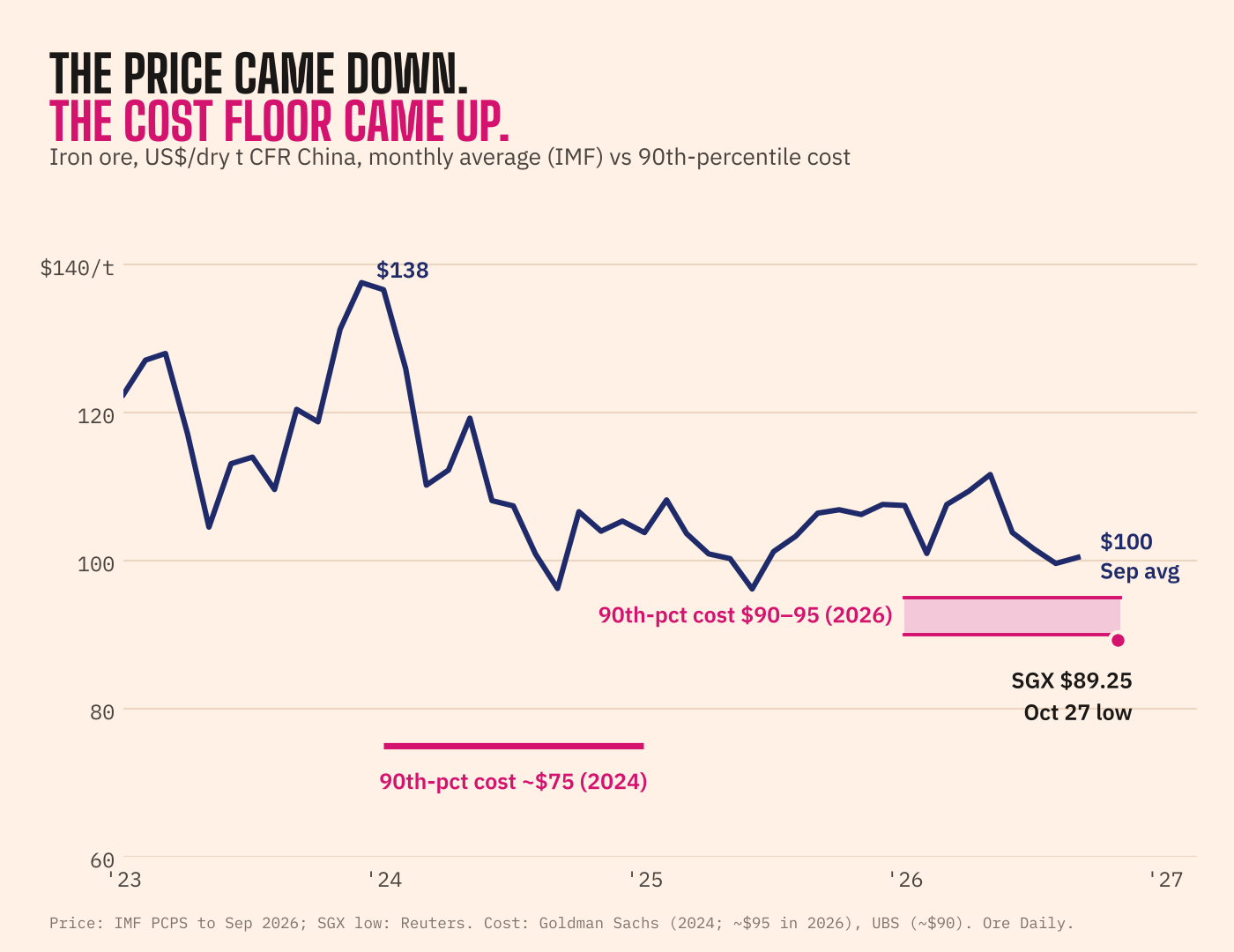
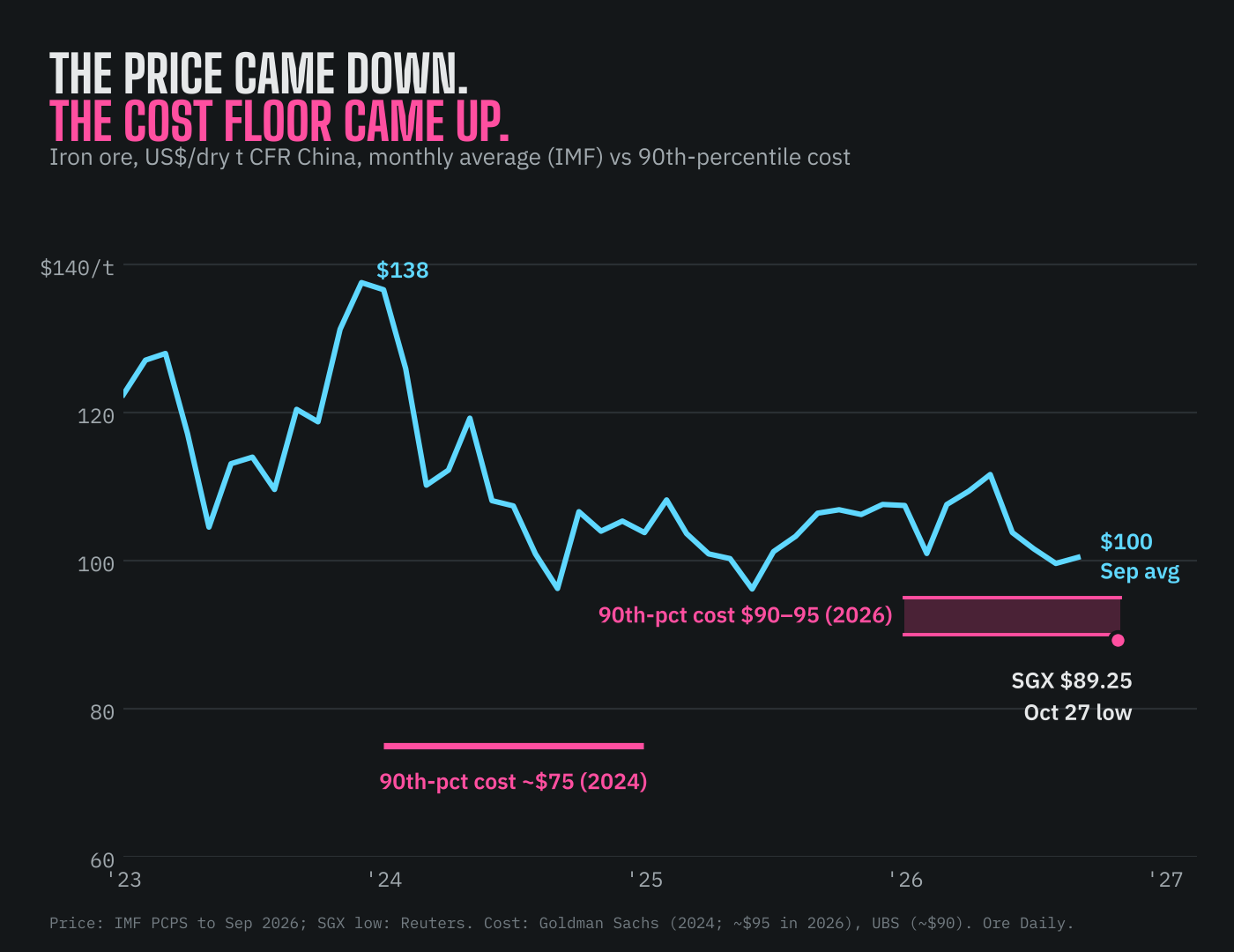
Iron ore has spent October testing who can live without a profit. Singapore futures touched US$89.25 on Oct 27, the lowest since September 2024 and 20% below May's US$111.60 peak, and the market headed for its lowest month-end close since October 2022.
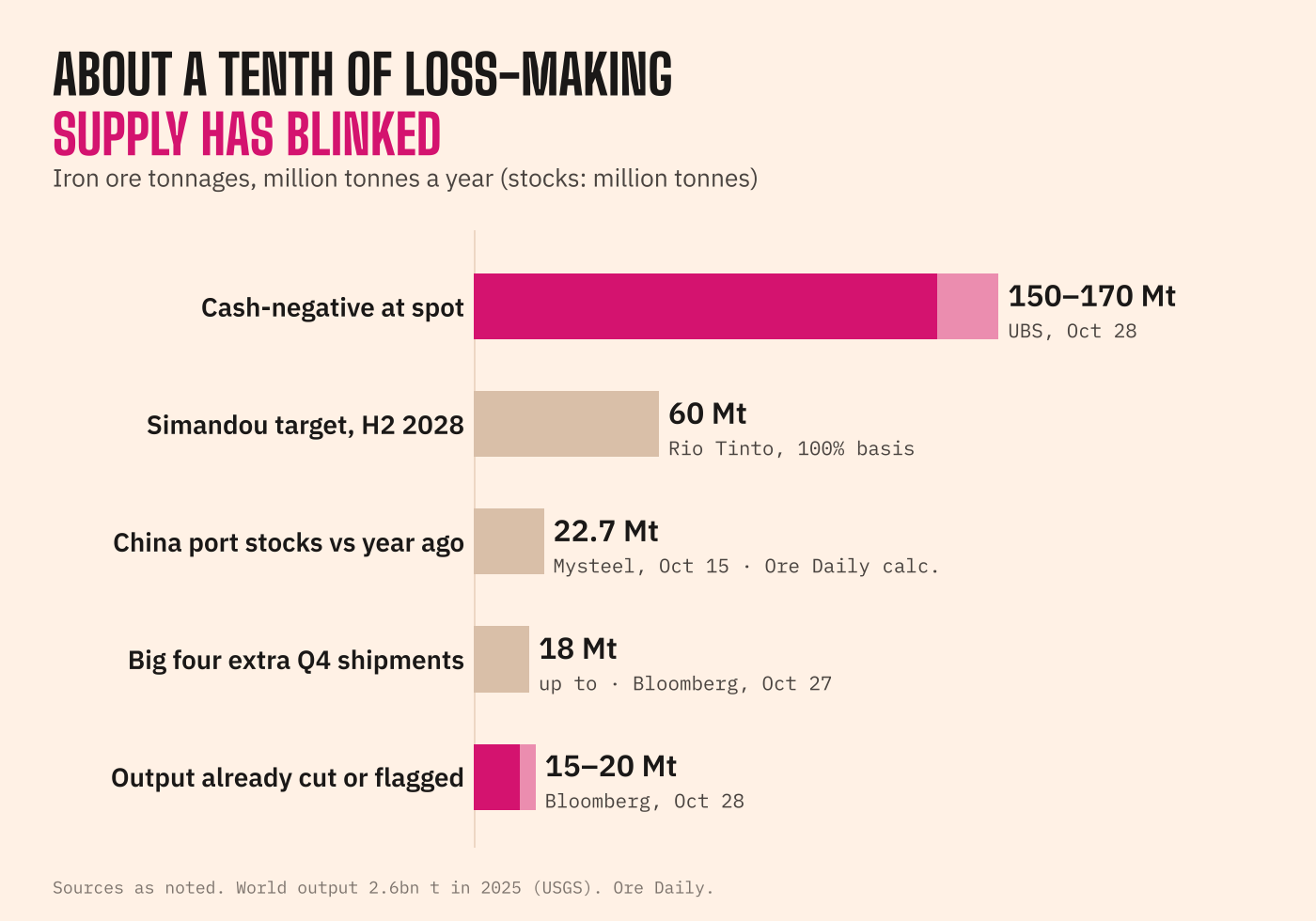
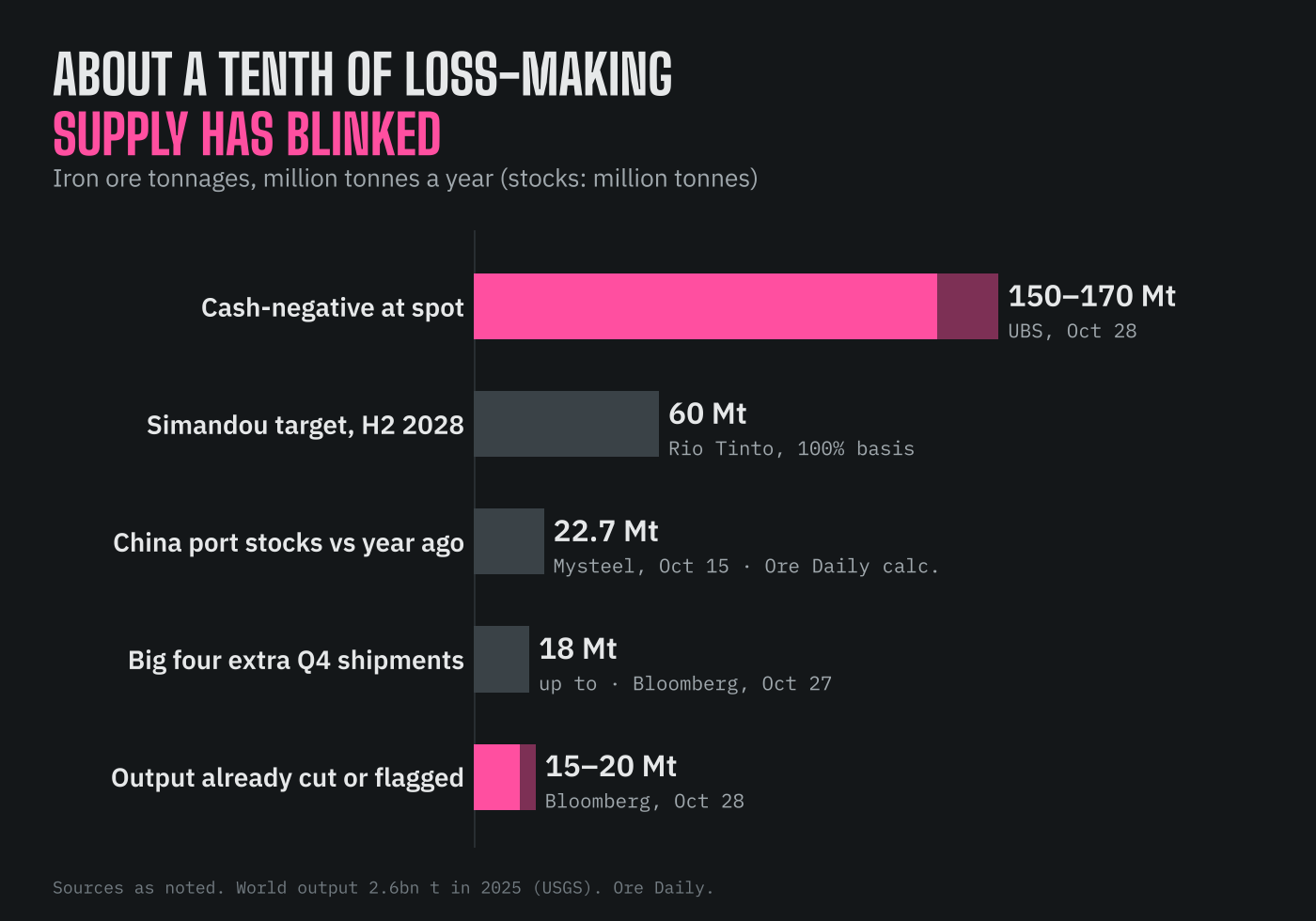
That puts the price inside the tail of the cost curve, not under it. UBS's Lachlan Shaw says sub-US$90 ore is broadly at the curve's 90th percentile and estimates 150–170Mt of supply is cash negative, about 6% of the 2.6bn t the world mined last year. Suppliers with 15–20Mt a year have cut or signalled cuts, Bloomberg reports. By Ore Daily's calculation that is roughly a tenth of the loss-making tonnes.
“We would estimate 150-170 million tons of supply is currently cash negative at today's spot prices”
The floor moved up
Part of the squeeze is on the cost side. Goldman Sachs puts the 90th-percentile, all-in cost at about US$95/t, up more than 20% from about US$75/t in 2024, driven by mining costs, freight and lower grades. In September it counted more than 200Mt that loses money at US$95 or less, and more than 350Mt at US$90 or less. The banks' tallies differ; Bloomberg notes cheaper Capesize freight has been offset by diesel and currency moves.
The squeeze shows at Vale. It realised US$85.1/t for fines in Q3, down 10%, while all-in cost rose 21% to US$60.4/t. That leaves about US$24.7/t of margin, against roughly US$44.6/t a year earlier, a 45% drop by Ore Daily's calculation. Vale's ADR closed at a 12-month low of US$11.18 on Oct 29. At the cheap end, Rio Tinto guides Pilbara cash costs to US$23.5–25.0/wet t FOB. The majors are squeezed, not threatened.
China is doing the cutting
The clearest retreat is inside China. Domestic iron ore output fell 10.3% in January–September and 23.9% in September, on NBS raw-ore figures. China's mines are low-grade and high-cost, and they are leaving first.
Seaborne ore is filling the gap faster than steel needs it. China's crude steel output fell 2.9% in the first nine months, while imports rose 4.1% to 955Mt. The difference is sitting at the ports: 173.7Mt on Oct 15, up about 15% on the year, or roughly 22.7Mt more ore by Ore Daily's calculation.
More is coming
The big four are not blinking. Bloomberg reports their Q4 shipments could rise by up to 18Mt. Simandou produced 2.5Mt in Q3, an annualised rate of about 10Mt, and targets 60Mt a year in the second half of 2028. That target alone equals 35–40% of today's cash-negative tonnes.
Shutting a mine costs money, so the response lags. Shaw says prices will need to stay low for longer before enough supply leaves to tighten the market. Goldman, in September, called US$90–95 a solid near-term floor; spot has already tested its lower edge.
What to watch
Demand is not coming to the rescue yet. China's official manufacturing PMI fell to 49.3 in October, against expectations of 50. Construction dropped 2.3 points to 48.0, and energy-intensive industries to 47.3.
Next: the IMF's October average, due in early November, and weekly port stocks. Watch also for named cuts from Indian low-grade exporters and smaller Brazilian producers, the tonnes Goldman flagged as most exposed. Simandou's Q4 run rate will show how fast the new supply arrives.
Sources Bloomberg via Yahoo Finance: Iron ore's drop below $90 tests high-cost supply, Oct 28 · MINING.COM (Reuters): Iron ore hits 2-year low, Oct 27 · Bloomberg: Iron ore heads for lowest month-end close since October 2022, Oct 30 · Hellenic Shipping News (Investing.com): Goldman Sachs sees support at $90-95/t, Sep 21 · Mining.com.au (Reuters): Vale Q3, Oct 29 · SteelOrbis: Rio Tinto Q3 2026, Simandou ramp-up · SteelOrbis (NBS): China iron ore output Jan-Sep 2026 · SteelOrbis (NBS): China crude steel output Jan-Sep 2026 · SteelOrbis (GACC): China iron ore imports Jan-Sep 2026 · Mysteel: China iron ore port stocks, Oct 15 · Miningmx (Bloomberg): Iron ore hits two-year low, Oct 27 · SMM (NBS): October 2026 PMI · IMF Primary Commodity Price System, iron ore (PIORECR)